Posts

Makhanda, hero of the amaXhosa, drowns in Big Bay, Blouberg

Image
On a dark August night in 1819, a group of prisoners escaped from Robben Island, stole three whaleboats, and made for the nearest part of the mainland, which happens to be Bloubergstrand. Amongst them was the amaXhosa mystic and warrior named Makhanda. He was also known as Mahala, Nxele (left-handed) and Lynx (possibly from ‘links’, the Afrikaans word for ‘left’, or after the wildcat of that name). Only one boat made it through the breakers and reached the beach at Big Bay; the other two capsized in the surf and most of the escapees drowned. Makhanda, who was either unable to swim or was badly injured, grabbed hold of a rock in the bay and his deep sonorous voice could be heard loudly encouraging those who were struggling to shore. Eventually, though, he was swept away and drowned. Makhanda is said to have been born somewhere along the Qhagqiwa River (Swartkops River) near to Uitenhage. His father was an amaXhosa man of lowly rank named Gwala, from the amaCwerha clan, and h...

The Cape Jij Rebellion of 1808

Image
The generally harsh conditions experienced by slaves and labourers on Western Cape farms, combined with news of the recent abolition of the slave trade on the high seas and uprisings by slaves in America, Ireland and the Caribbean, no doubt inspired the first uprising by slaves and servants at the Cape. The leaders were an ethnically mixed band: a slave tailor by the name of Louis van Mauritius; two Irishmen, James Hooper and Michael Kelly; another slave, Jeptha van Batavia; as well as two more slaves, Abraham and Adonis. An Indian slave and two Khoekhoe men later joined them. Their plan was to march from the rural districts, gathering slaves along the way, and then to enter Cape Town, seize the Amsterdam Battery, turn the guns on the Castle, and then negotiate a peace which would involve establishing a free state and freedom for al l slaves. On the evening of 27 October 1808, on the farm  Vogelgezang (Birdsong), just north of Malmesbury, which was owned by  Gerhardus Lou...

The Battle of Blaauwberg

Image
During the Napoleonic Wars, the British decided to seize the Cape in order to prevent it —and the strategically important sea route to the East — from coming under French control. A British fleet was despatched to the Cape in July 1805, to forestall French troopships which Napoleon   had sent to reinforce the Cape garrison. The first British warship reached the Cape on Christmas Eve 1805, and attacked two supply ships off the Cape Peninsula. Lieutenant General Jan Willem Janssens, the Batavian Governor of the Cape, placed his garrison on alert. The Dutch forces were small and of poor quality, and included foreign mercenary units hired by the Batavian government. They were backed up by local militia   units. When the main fleet sailed into Table Bay   on 4 January 1806, Janssens mobilised the garrison, declared martial law, and called up the militia. After a delay caused by rough seas, two British infantry brigades, under the command of Lt General Sir David Bair...

The Milnerton Lagoon: Part 2

Image
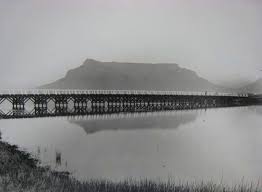
The Wooden Bridge In 1900-01, the Fortress Company of the Royal Engineers constructed a single-lane wooden bridge to give troops access to the “island” on the sea side of the lagoon, and thence up the coast. This bridge, made of jarrah (an Australian hardwood), was intended to be a temporary structure, but it is still standing to this day and is commonly known as “The Wooden Bridge”. The same Company built a similar bridge as a viaduct for the railway over the Salt River mouth, but this structure was demolished once the railway was no longer in operation.                                                                                                  The wooden bridge c. 1903 (Photo: Ravenscroft Collection)       ...

The Milnerton Railway

Image
In May 1898, Milnerton Estates requested permission of the Cape Parliament to build a railway line to a terminus on Jan Biesjes Kraal. Permission was granted and in April 1899, tenders were called for the construction of the Milnerton Railway.  There was already a line heading north from Cape Town, which crossed the Salt River near Koeberg Road, but negotiations with the Cape Government Railways (CGR) resulted in a decision to link up with the existing network nearer Cape Town at Craig’s Crossing, which was a road traffic bridge giving access to the defensive fort named Craig's Tower, situated on Woodstock beach.                                                                 Blackie, the first locomotive in South Africa, crossing the bridge across the Salt River c. September 1861         ...